


Getting your ring size spot on is the first and most crucial step towards finding that perfect piece of jewellery. The great news is that you can get a reliable measurement right from home, either by using a bit of string or paper or by checking a ring you already wear and love. Knowing how to measure ring size accurately means your next ring will fit comfortably from the moment you unbox it.
Finding Your Perfect Ring Fit at Home
Shopping for rings online gives you endless options, but it always comes with that one big question: "What's my size?" You do not actually need a trip to the jeweller or any fancy tools to figure it out. With a couple of common household items, you can get a measurement that is surprisingly precise.
We are going to walk through two trusted methods that anyone can do. The first uses a simple piece of string or a strip of paper to wrap around your finger. The second, and often easier, method is to measure a ring you already own that fits perfectly. Both work well, but getting it right is all in the details.
Why Accuracy Is So Important
Getting the size wrong is more than just a small inconvenience. A ring that is too tight is uncomfortable and can even get stuck, while one that is too loose is a constant worry because it could slip off and be lost forever. Taking a few extra minutes to measure correctly saves you the hassle of returns, resizing fees, and disappointment, especially for something as meaningful as an engagement ring.
Beyond the actual measurement, a few other things can subtly change your ring size, often without you even noticing. Your fingers can swell and shrink slightly throughout the day.
- Time of Day: Fingers tend to be a little smaller in the morning and swell as the day goes on. For the most accurate reading, it is best to measure in the late afternoon.
- Temperature: Cold weather can make your fingers shrink, while heat and humidity do the opposite. Always measure when you are at a comfortable and normal room temperature.
- Your Knuckles: If your knuckles are larger than the base of your finger, you will need a size that can just slip over them but will not be too loose once it is on.
The sweet spot is what we call a "snug but comfortable" fit. The ring should go over your knuckle with a little bit of a push but should not feel tight or constricting at the base. It definitely should not be spinning around or feel like it could fly off when you wave your hand.
Understanding these little details is just as critical as the measurement itself. It is like learning about the quality of the materials in your jewellery. For instance, you can dive into the characteristics of natural diamonds in our detailed guide. Knowing what affects the fit is the key to choosing with confidence and getting it right the first time.
Getting an Accurate Fit With String or Paper
The string or paper strip method is a classic for a good reason as it is something everyone has at home, it is quick, and it works surprisingly well when you are careful. The whole idea is to create a little makeshift "ring" that gives you a perfect idea of how the real thing should feel.
All you need are a few simple items: a piece of string that does not stretch (dental floss is perfect for this), a thin strip of paper, a fine tipped pen, and a ruler that shows millimetres. People often ask whether string or paper is better. Honestly, it is down to preference, but I find a paper strip that is about 5-6 mm wide is often easier to mark clearly.
Nailing the Measurement
This is where precision really counts. You need to wrap the string or paper around the base of your finger, exactly where the ring will eventually sit. It should rest comfortably below your knuckle.
Once it is in place, pull it so it is snug. And by snug, I mean not tight enough to dig into your skin, but definitely not loose enough to have any slack. Think about how you would want your ring to feel: secure enough that it will not slip off, but with enough room to be comfortable all day.
A common mistake I see is people pulling the string way too tight. This can easily lead to a measurement that is a full size too small. The fit should feel more like a firm hug rather than a squeeze.
Holding the paper or string snugly, use your pen to make a sharp and clean mark right where the end overlaps. A blurry or thick line can throw your measurement off by half a size, so a fine point is your best friend here.
This visual guide walks you through the key points for getting an accurate measurement at home.
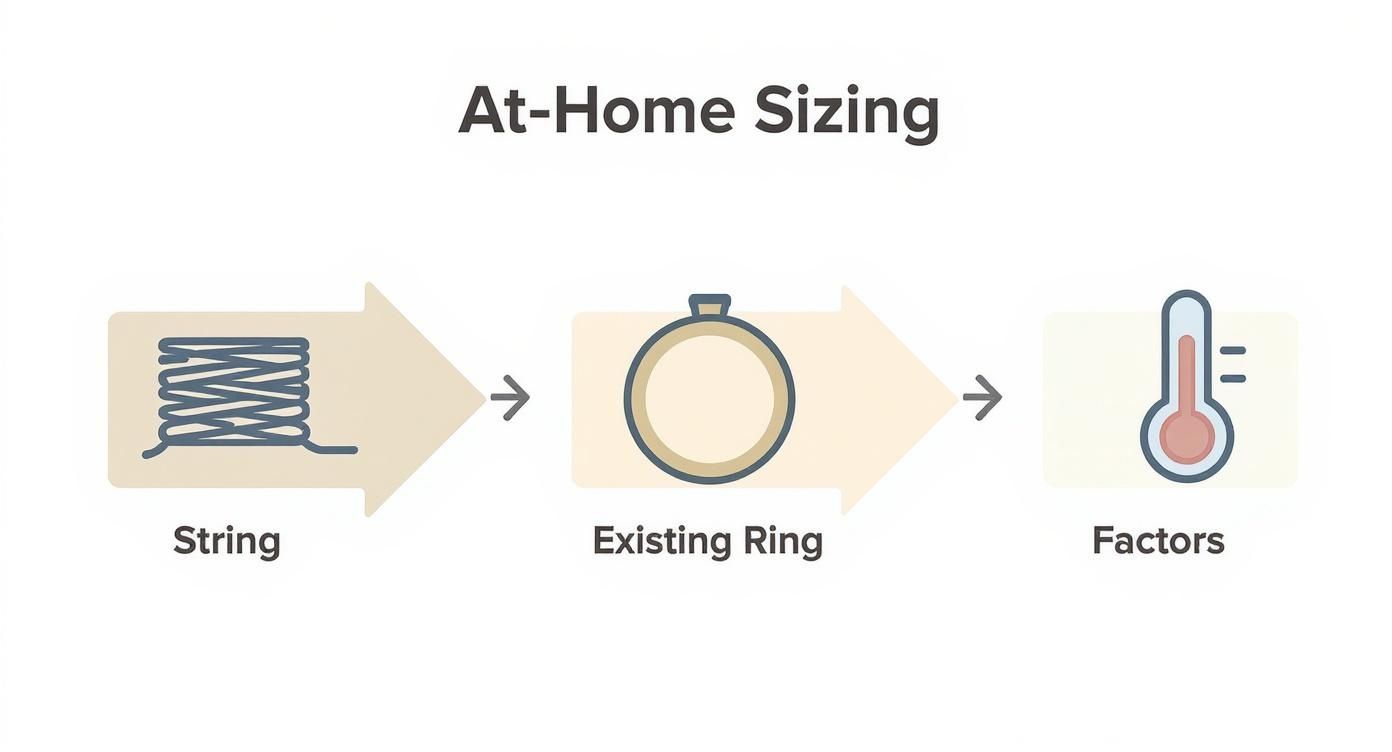
As the infographic shows, getting it right is all about using the proper tools and being aware of little things like how warm or cold your hands are.
From Millimetres to Your Perfect Ring Size
Once you have made your mark, carefully unwrap the paper or string and lay it flat against your ruler. Now, measure the length from the starting end to the mark you made. That number in millimetres is the circumference of your finger.
This measurement is fantastic, especially if you are shopping for European brands like we carry at WatchClick. Why? Because the European (ISO 8653) sizing system is wonderfully straightforward: the size is the circumference.
- If your measurement comes out to 54 mm, your ring size is 54.
- If you measure 62 mm, your ring size is 62.
This direct 1-to-1 relationship takes all the guesswork out of converting sizes, which makes it an incredibly reliable method for our customers in Croatia and across Europe. For example, knowing your exact circumference means you can confidently pick out a piece from stunning collections like those from PDPaola or Brosway.
To be absolutely sure, I always recommend measuring two or three times. Our fingers can swell and shrink a little throughout the day, so taking an average of a few readings will give you the most accurate and trustworthy result.
Common Pitfalls to Avoid
Even when you are being careful, it is easy to make a small mistake. Knowing what to look out for is half the battle.
A very common error is using a material that stretches. Stay away from yarn, elastic bands, or any craft string with a bit of give. These will stretch as you pull them taut, giving you a measurement that is much smaller than your actual finger.
Another thing to watch is the width of the paper you are using. If your strip is too wide (say, more than 6 mm), it starts to act like a wide band ring. Wider rings always fit more snugly, so a wide piece of paper can lead to a size that feels too tight when you get a standard width ring. Keep the strip narrow to get a true baseline measurement that works for most common ring styles.
Using a Ring You Already Own for a Perfect Match
If you have got a ring that already fits you like a dream, you are in luck. This is hands down one of the most reliable ways to find your size because you are working with a real world example of what feels comfortable on your finger. It takes all the guesswork out of the equation, which is far better than fiddling with a piece of string.
There are two easy ways to do this. The first is a straightforward measurement with a ruler, and the second involves a printable chart where you match your ring to the right size. Both work well, so pick whichever one you have the tools for.
Method 1: Grab a Ruler and Measure the Diameter
This is as simple as it sounds. All you need is your go-to ring and a ruler that shows millimetres. Precision is key here, so make sure the markings on your ruler are clear and easy to read.
Pop your ring on a flat surface and line the ruler up straight across the middle. You are measuring the internal diameter, which is the distance across the empty space inside the ring from one side to the other.
Be careful not to include the metal band in your measurement. That is a common mistake, and it will lead you to buy a ring that is too big.
- Measure straight across the widest part of the circle.
- Do not measure from the outside edges of the metal.
- Note down the measurement in millimetres for the best accuracy. You might get something like 17.2 mm.
Once you have that number, you can pop it into an international ring size conversion chart (we will get to that in a bit) to find your corresponding size. This gives you a concrete measurement, making online shopping a whole lot less stressful.
Method 2: Use a Printable Ring Sizer Chart
Another great option is to use a printable ring sizer chart. These are easy to find documents online that feature a series of circles where each one matches a standard ring size. The goal is to lay your ring over the circles to find its perfect match.
The most important thing here is to print the chart at 100% scale. Your printer might try to automatically "fit to page," which will shrink the circles and throw off your measurement completely. Before you hit print, check the settings and make sure it is set to "100%" or "Actual Size."
With your chart printed correctly, just place your ring over the circles. Keep moving it until you find the one where the black line of the circle is just visible all the way around the inside of your ring. The inner edge of your ring should line up perfectly.
If you find your ring is somewhere between two sizes, always go for the larger one. A ring that is a tiny bit loose is still wearable while one that is too tight is just going to sit in your jewellery box. This visual method is also a clever way to find someone’s size for a surprise gift like a unique ring watch for someone special, if you can sneakily borrow one of their rings for a minute.
No matter which method you choose, your result is only as good as the ring you use for reference. Try to pick one with a similar band width to the new ring you want to buy. A really wide band (think 6 mm or more) will always feel tighter than a thin and delicate one. Using a ring of a similar style will give you the most accurate and dependable result.
Decoding International Ring Size Standards
Once you have your finger's measurement in millimetres, you have basically unlocked the ability to buy rings from almost anywhere in the world. The only catch is that different countries use different sizing systems.
You might notice a jeweller in London describing a ring as size "M," while an American brand calls the exact same ring a "6.5." This is where a little knowledge of international ring sizes goes a long way, giving you the confidence to shop globally without a second thought.
The Standard in Croatia: European Sizing
Luckily for us in Croatia, the system is wonderfully straightforward. We, along with most of Europe, follow the ISO 8653:2016 standard. It is simple as the ring size is its inner circumference in millimetres.
So, if a ring is size 50, its inner circumference is exactly 50 mm. There are no weird calculations or conversions to worry about. This direct relationship makes measuring at home incredibly reliable. If you use the string method and find your finger's circumference is 56 mm, your European ring size is simply 56.
This is a huge advantage. It means you can measure your finger at home with a high degree of confidence, knowing that the number you get with your ruler directly translates to the size you will see on our site for brands like PDPaola or Brosway.
This system is not just used in Croatia; it is the standard across most of mainland Europe including Germany, France, and Italy. That consistency makes shopping for jewellery within the EU a breeze. If you want to dive a little deeper, you can find more insights about average ring sizes on blakebros.com.
Converting Between Global Standards
So, what happens when you fall in love with a ring from a UK or US-based designer? That is when a good conversion chart becomes your best friend. Think of it as a universal translator for ring sizes.
For example, a European size 54 (meaning a 54 mm circumference) is roughly the same as a US size 7 or a UK size N ½. It is worth noting that conversions can sometimes land between half sizes because the increments in each system are not identical.
Here is a quick rundown of the main systems you will run into:
- European (ISO 8653): Based on the inner circumference in millimetres. It is the most direct and easiest to measure yourself.
- US & Canada: A numerical scale, usually from 3 to 13, that includes half and even quarter sizes.
- UK, Australia & Ireland: An alphabetical scale starting from A (the smallest size) and going up, also with half sizes.
Having a chart on hand takes all the guesswork out of ordering from international brands. It ensures that the effort you put into learning how to measure your ring size pays off no matter where your perfect ring is coming from.
International Ring Size Conversion Chart
To make things easy, we have put together a clear conversion table. Use this as your go-to reference whenever you're shopping for rings online. Just find your measurement in millimetres or your known size in one system to see how it translates to the others.
| Circumference (mm) | Diameter (mm) | European Size (ISO 8653) | US & Canada Size | UK & Australia Size |
|---|---|---|---|---|
| 49.3 mm | 15.7 mm | 49 | 5 | J ½ |
| 51.9 mm | 16.5 mm | 52 | 6 | L ½ |
| 54.4 mm | 17.3 mm | 54 | 7 | N ½ |
| 57.0 mm | 18.1 mm | 57 | 8 | P ½ |
| 59.5 mm | 18.9 mm | 60 | 9 | R ½ |
| 62.1 mm | 19.8 mm | 62 | 10 | T ½ |
| 64.6 mm | 20.6 mm | 65 | 11 | V ½ |
| 67.2 mm | 21.4 mm | 67 | 12 | X ½ |
With this chart, you can confidently switch between European, US, and UK sizes, ensuring you always get the perfect fit.
Insider Tips for a Flawless Ring Fit
Simply wrapping a string around your finger is a great start, but getting a truly perfect fit involves a little more nuance. As experienced jewellers, we know a few things can make all the difference. Your body is dynamic, and your fingers actually change size slightly throughout the day and even with the seasons.
Think of it this way: your fingers are at their slimmest first thing in the morning or when you are feeling a bit cold. As your day gets going, things like heat, your activity level, and even the food you eat can cause them to swell a little.
For the most accurate reading, try measuring at the end of the day when your finger is likely at its largest. Make sure you are at a comfortable room temperature too, so not right after a freezing winter walk or in the middle of a summer heatwave.
Consider How Band Width Affects Fit
This is one of the most overlooked details when sizing a ring at home, and it is absolutely crucial. The width of the band itself dramatically changes how a ring feels on your finger.
A thin and delicate band only touches a small part of your skin, so it will generally feel true to size. But a wider band, anything over 6 mm, covers much more real estate. It displaces more of your finger, creating a much snugger feel.
It is a bit like shoes where a wide sandal feels completely different from a tight fitting boot, even if they are supposedly the same size. For wider rings, most people find they need to size up for a comfortable fit.
As a rule of thumb, we recommend going up by a quarter to a half size for every 2 mm of width beyond a standard 4 mm band. So, if you are eyeing an 8 mm comfort fit band, you should probably go up at least a half size from what a thin sizer tells you.
Mastering the Knuckle Challenge
What if your knuckle is noticeably bigger than the base of your finger? This is an incredibly common situation that can make finding the right size feel like solving a frustrating puzzle. The goal is to find a ring that can get over the knuckle but will not spin around like a top once it is on.
The secret is to find a size that requires a little bit of gentle persuasion to go on. You should be able to ease it over the knuckle with a slight twist, but it should not just slide on without any effort.
Here are a few strategies to tackle it:
- Measure Both Spots: Get the measurement for your knuckle and for the base of your finger where the ring will sit. Your perfect size is likely somewhere in between.
- Aim for Snug, Not Strangled: Once the ring is on, it should feel secure at the base without causing a "muffin top" effect or feeling uncomfortably tight.
- Look for a 'Comfort Fit': Many rings, especially in men's styles, are designed with a slightly domed interior. This clever design helps the ring slide over a larger knuckle while still fitting snugly at the base.
Sometimes, the feeling of a ring has less to do with size and more to do with the metal itself. Certain alloys can cause skin reactions, which is a different problem but still affects comfort. To learn more, check out our guide on why some jewellery turns your skin green and what you can do about it.
The Role of Diet and Hydration
Believe it or not, what you had for lunch can affect your ring size. A salty meal can make you retain water, causing your fingers to puff up temporarily. On the other hand, being dehydrated can make them shrink a bit.
While these changes are usually small, they really highlight why measuring a few times on different days is a smart move. Research has even shown that seasonal changes have a noticeable effect. For example, in Croatia where women’s ring sizes typically fall between the European standard of 50 to 54, studies have found that finger circumferences can be about 1.2 mm smaller in the winter compared to the summer. This is all down to how our bodies react to temperature.
Keeping these insider tips in mind will help you move past a simple measurement and toward choosing a ring size with real confidence.
When It Is Time to Call in a Professional
While our at home methods are fantastic for getting a reliable measurement for most rings, some moments call for absolute precision. Think about those truly special and once-in-a-lifetime purchases like an engagement ring, a wedding band, or a milestone anniversary gift. For these pieces, visiting a professional jeweller is not just a good idea but also the smartest investment you can make in getting the fit perfect from the start.
You are not just paying for a measurement as you are tapping into years of experience. A professional jeweller uses tools that simply can't be replicated with a piece of paper or string. We are talking about precision calibrated equipment designed for one job: finding the exact size for a rigid metal band.
What is more, a skilled jeweller brings a trained eye to the process. They will notice things you might not such as whether you have a larger knuckle that requires a slightly bigger size to slip over, or how the width of a particular band will affect how it feels on your finger. They can give you practical advice on how a chunky and wide band will fit differently than a delicate thin one by ensuring the ring you choose is comfortable enough to wear every single day.
The Tools of the Trade
Step into any reputable jewellery shop, and you will see two key tools that take all the guesswork out of sizing. Knowing what they are will give you confidence in the result.
- Sizing Rings: This is the most straightforward tool, consisting of a set of metal rings covering every possible size including half sizes. You simply try them on until you find the one that gives a little resistance going over the knuckle but sits snugly and comfortably at the base of your finger. It is a hands on and practical way to feel what works.
- Ring Mandrel: This is a tapered metal cone marked with sizes. It is used to find the size of a ring you already own and love. The jeweller just slides the ring down the mandrel, and wherever it stops, that is its true size. It is the definitive way to know the size of a ring that already fits you perfectly.
These tools offer a level of accuracy that removes all doubt. That is exactly the kind of peace of mind you need when you are investing in a piece of jewellery meant to last a lifetime.
The Future is Digital
The world of jewellery is also embracing technology to make sizing even more accurate and convenient. New digital tools and mobile apps are popping up that use your smartphone’s camera to measure your ring size. Some apps ask you to place an existing ring on your screen, while others use the camera to scan your finger and calculate its dimensions.
While the reliability of these apps can still be a bit hit or miss, they are getting better all the time. Many now use a standard credit card for scale, which dramatically improves their accuracy. They offer a great middle ground for anyone wanting a more precise measurement without having to leave the house.
This move towards digital precision is already becoming standard practice in professional circles. In Croatia, for example, around 30% of jewellers in major cities like Zagreb are now using electronic sizers. These devices photograph a person's finger and use image recognition to calculate the dimensions with an accuracy of within 0.1 mm, making the entire process faster and more reliable. You can read more about how digital tools are changing ring sizing on jaxxon.com.
As this technology continues to improve, it is set to make buying rings online a much more confident experience. Imagine getting a jeweller quality measurement from an app on your phone and then ordering a custom ring from anywhere in the world, knowing it will fit perfectly. It is the best of both worlds with professional accuracy right from the palm of your hand.