


To understand the story of the NATO strap, you first have to forget the "NATO" part. Its true origins lie with the British Ministry of Defence (MoD), born from a practical need for a watch strap that wouldn't fail a soldier in the field. Its original nickname, the G10, came from the requisition form used to get one.
This small detail tells you everything about the strap's no-nonsense, functional military roots.
The True Story Behind a Military Icon
It is a common misconception that the strap's creation is directly linked to the North Atlantic Treaty Organization. The name is related, but the story begins with a classic military problem of keeping a watch securely on a soldier's wrist during combat. Standard two-piece leather straps simply were not reliable enough.
This push for durability and security was a major theme in military timepieces, a topic you can explore in our article on WW2 watches. The mission was all about function, not fashion, which is a principle that would define the strap for decades.
The Real 'G10' Nickname
The strap's most authentic name isn't "NATO." British soldiers simply called it the "G10." That name came straight from the G1098 requisition form they filled out to get one from the quartermaster's stores.
This pragmatic origin story really drives home its status as standard issue equipment as it was a tool, not an accessory. The name stuck, and to this day, you will hear purists and collectors refer to it simply as a G10.
So where did "NATO" come from? The term caught on much later. It became the popular civilian name because the strap was assigned a NATO Stock Number (NSN), a code used to catalogue all military supplies.
Early Nylon Innovators
The road to the G10 we know today started long before its official standardisation. The British Royal Air Force was already pioneering nylon watch straps back in 1954 when they issued the 6B/2617 model.
This early design predated the official MoD standard by nearly two decades, but it set the stage. As this informative article from Strapsco explains, these initial experiments with nylon proved the material's strength and reliability, paving the way for the iconic strap.
From Defence Standard to Iconic Design
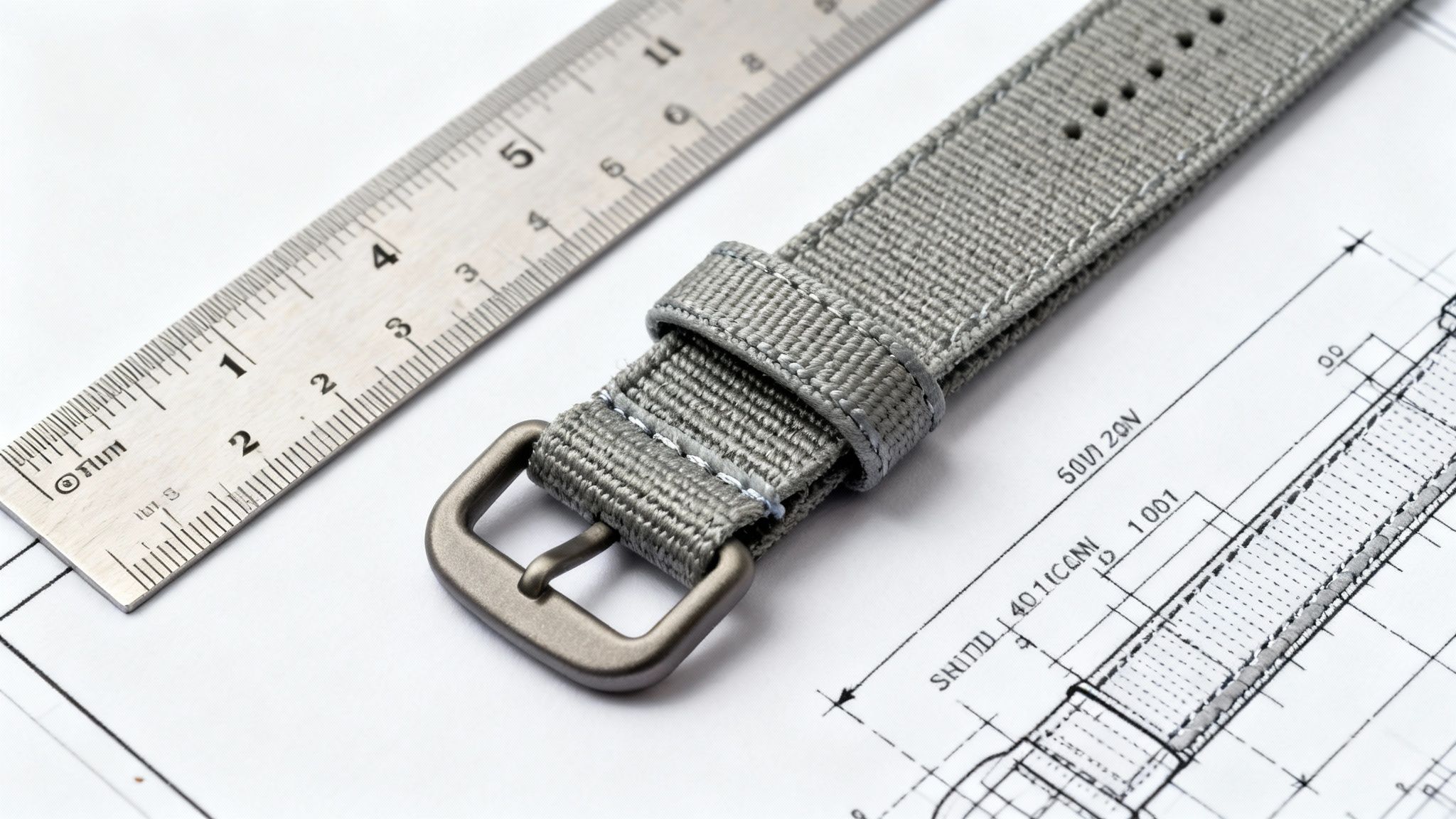
While early nylon straps were already in use, the story of the G10 as we know it truly took shape in 1973. That was the year the British Ministry of Defence (MoD) published Defence Standard 66-15, a document that laid out every detail of the strap. It was no longer just a concept; it was now a precise piece of military gear.
This standard was not a casual guideline as it was the official blueprint. It dictated everything from the woven nylon material to the specific construction methods. The objective was pure function and absolute reliability for soldiers in the field. For a closer look at timepieces built for those conditions, you can explore our list of the best military watches, which are a natural fit for this historic strap.
The Blueprint of a Legend
The DefStan 66-15 document outlined several key requirements that gave the strap its unique character and strength. These were not random choices as each one served a clear and practical purpose that built its legendary durability. The entire history of the NATO strap is rooted in this meticulous and purpose driven design.
Here is what the MoD demanded:
- Material: It had to be a strong and non laminated nylon fabric that is chosen for its resistance to rot, moisture, and abrasion.
- Construction: All joints, keepers, and the buckle were to be heat welded, not stitched. This thermal bonding created a seamless connection that was incredibly strong and could not unravel like traditional thread.
- Colour: The original and only specified colour was a simple and no nonsense Admiralty Grey.
That detail about welded construction might seem small, but it is crucial. Stitching can fail under heavy stress or degrade in damp environments, but a heat welded joint essentially melts the nylon fibres together, creating a bond as strong as the material itself.
Security Through Simplicity
Beyond its rugged build, the true genius of the G10 lies in its pass through design. The single piece of nylon threads behind the watch case, looping through the spring bars. An additional shorter flap of nylon secured by a metal keeper passes under the watch, creating a "lock."
This ingenious second loop is the strap's most important safety feature. If one of the watch's spring bars were to break or pop out during intense action, this keeper ensures the watch head remains secured to the strap and, by extension, to the soldier's wrist.
The MoD specified a lot more than just the basics. In the table below, you will see how the official standards evolved over time.
Key Milestones in NATO Strap Specification History
The MoD's Defence Standard, or "DefStan," was not a static document. It was updated to reflect new requirements and equipment, showing the strap's ability to adapt.
| Milestone | Year | Key Specification Details |
|---|---|---|
| DefStan 66-15 Issued | 1973 | The original standard is published. It specifies the single piece nylon design, heat welded construction, Admiralty Grey colour, and a standard width of 18.0mm. |
| DefStan 66-47/2 Issued | 2001 | The standard is updated in March. The most significant change is the official width, which is increased to 20mm to fit the newer and larger military issue watches. |
These updates show how a simple and effective design can be maintained while adapting to modern needs. This is what separates a true, military spec G10 strap from its countless imitators, as you can discover in this deep dive into Mil-Spec history. The core principles of security and durability have always remained the same.
The Journey into Civilian and Fashion Worlds
The G10 strap's leap from military kit to fashion accessory was not the result of a clever marketing plan. It was a gradual and organic shift fueled by a fascination with functional design, and a big nudge from the world's most famous secret agent. Its rugged looks and practical design started to resonate well beyond army barracks, kicking off a new life for the humble strap.
Long before it was a go-to for watch collectors, the strap had its big screen moment. That single appearance would lock it into pop culture forever and introduce its distinct style to millions.
The Bond Effect
The turning point was the 1964 James Bond film Goldfinger. Audiences watched Sean Connery wear his Rolex Submariner not on its usual steel bracelet, but on a striped nylon strap. It was a choice that perfectly telegraphed his character's mix of elegance and gritty, get the job done attitude.
Technically speaking, the strap on Connery's wrist wasn't the official 1973 MoD spec G10. It was a bit too narrow for the watch's lugs and had a simpler buckle, but that did not matter. The impact was huge. This was one of the first times a military style strap showed up in a civilian context, instantly linking it with adventure, confidence, and effortless cool.
The "Bond NATO," as it is now affectionately called, is still one of the most popular colour schemes. It is a great example of how one powerful image can define a simple and functional object for generations.
From Surplus Stores to Online Shops
After its starring role, the strap began to trickle down to the public through more traditional channels. At first, genuine G10s could only really be found in military surplus stores. For years, these shops were the only place for people who appreciated authentic and battle tested gear.
As interest picked up through the 1980s and 1990s, outdoor enthusiasts and a few speciality watch shops began stocking them. But the real game changer was the internet. In the early 2000s, e-commerce made NATO straps available to anyone with an internet connection. As this resource on the strap's developmental milestones points out, this sudden accessibility lit the fuse for a creative explosion.
A Canvas for Creativity
With the whole world watching, variety became the name of the game. Manufacturers started producing straps in every colour and pattern imaginable, leaving the original Admiralty Grey far behind. The once uniform military strap had become a blank canvas for personal style.
This evolution meant watch owners could completely change the vibe of their timepiece in about a minute. A serious dive watch could be dressed down for summer with a bright and colourful strap. A classic field watch could get an extra dose of authenticity with an olive drab version. The NATO strap had finally arrived, transforming from a purely functional tool into a versatile and much loved style icon.
Understanding Different Strap Designs
Once the G10 strap caught on, its core design sparked a whole family of similar pass through straps. You will often hear the names used interchangeably, but there are some real and practical differences between them. Knowing how to spot these distinctions is key to finding the right strap for your watch and your style.
Each variation offers a slightly different feel on the wrist. One might be a better fit for a chunky dive watch, while another slips perfectly under a shirt cuff. The story of the NATO strap isn't just about one design; it is also about the styles it inspired.
The Classic NATO or G10 Strap
The genuine NATO, the one based on the original MoD specification, is defined by its clever dual loop system. It is made of one long piece of nylon that threads through your watch's spring bars, plus a shorter flap that sits behind the watch head. This extra piece is held down by a keeper, creating the strap's signature fail safe feature.
This construction is typically made from a thinner and more flexible nylon, allowing the excess tail of the strap to be folded back and tucked neatly into the keepers. The hardware is another clear indicator.
- Keepers: Look for two rectangular or squared off metal keepers on the strap, plus a third on the buckle itself.
- Buckle: It usually has a simple and flat pin buckle.
- Wear: That extra flap lifts the watch just a fraction off the wrist, which some people love.
This classic setup gives you ultimate peace of mind. If one spring bar ever gives way, your watch isn't going anywhere.
The Bold ZULU Strap
At first glance, a ZULU strap might look just like a NATO, but the details give it a much more rugged and overbuilt character. The most obvious difference is the hardware as it is bigger and beefier in every way.
ZULU straps are built for toughness. They use thicker, often stiffer nylon and feature large, oval or rounded keepers instead of the NATO’s squared ones. This gives them a bolder and more tool like appearance that pairs well with larger dive or field watches.
ZULUs generally come in two flavours: a five-ring version that works just like a NATO with the extra security flap, and a simpler three-ring version that functions as a single pass through strap, ditching the flap entirely.
The Streamlined RAF Style Strap
The third common variant is what many call the RAF style or single pass strap. Just as the name implies, it gets rid of the extra keeper and security flap you see on a true G10. The design could not be simpler: it is just one continuous piece of nylon that slides behind the spring bars.
This minimalist approach gives you a much slimmer profile on the wrist because the watch sits directly against your skin. It is a fantastic choice if you find a standard NATO sits a bit too high or feels bulky. You lose the secondary security loop, but you still keep the main benefit as your watch stays put even if one spring bar breaks.
With all these terms floating around, it can be tough to keep them straight. Here is a quick glance table to help you spot the differences.
NATO vs ZULU vs RAF Style Straps at a Glance
| Feature | True NATO (G10) | ZULU Strap | RAF Style (Single Pass) |
|---|---|---|---|
| Construction | Dual layer with a secondary flap for security | Can be dual layer (5-ring) or single pass (3-ring) | Single pass, no secondary flap |
| Material | Thinner, more pliable nylon weave | Thicker, stiffer nylon weave | Similar thickness to NATO, but can vary |
| Hardware | Thin, squared or rectangular keepers; simple pin buckle | Thick, rounded or oval keepers; substantial pin buckle | Usually a single fabric or thin metal keeper |
| Profile on Wrist | Sits slightly higher due to the extra nylon layer | Sits highest (5-ring) or high due to material thickness | Sits lowest, closest to the skin |
| Best For | All around use, from field watches to chronographs | Larger, heavier watches like divers and pilot watches | Slimmer watches or a lower profile look |
Ultimately, the choice comes down to personal preference for aesthetics and how you want the watch to feel on your wrist. Each style carries that same military inspired DNA, just executed in a slightly different way.
How to Choose and Style a NATO Strap Today
With its roots planted firmly in military history, the NATO strap has blossomed into one of the most versatile tools for any watch lover. It is a way to completely transform the look and feel of your favourite timepiece. But choosing the right one isn't just about picking a colour you like. It is about matching the material, hardware, and proportions to the watch itself.
First things first, you need to get the size right. This comes down to your watch's lug width, which is the space between the two arms where the strap connects. It is a simple measurement, usually 18mm, 20mm, or 22mm, but it is absolutely crucial. A strap that is too narrow will slide around and look off, while one that is too wide simply won't fit.
Finding the Perfect Material and Hardware
Once you have your lug width sorted, the fun part begins. The classic choice is woven nylon, just like the originals. But today, you will also find straps made from a premium "seatbelt" weave. This is a much tighter and denser weave of nylon that gives the strap a silky smooth finish and a bit of a sheen. It feels great on the wrist and adds a touch of refinement.
The hardware, including the buckle and the metal keepers, also makes a huge difference. You will typically find three main finishes:
- Polished: Bright and shiny, this is a good match for watches with a polished case or dressier vibe.
- Brushed: A matte and satin finish that looks right at home on rugged tool watches like divers and field watches.
- PVD Coated: This is a tough black coating that delivers a tactical and stealthy look. It is the perfect partner for any military inspired watch.
Matching the hardware to your watch case is a safe bet for a clean and cohesive look. But do not be afraid to mix it up for a more casual, devil-may-care attitude. There are no strict rules. For a more detailed breakdown, our complete guide on how to choose a watch strap goes even deeper.
Styling Your Watch with a NATO Strap
This is where the magic happens. A quick strap change can give a single watch a dozen different personalities. The NATO was born from pure function, but its modern appeal is all about style and versatility.
The real beauty of a NATO strap is its ability to instantly change the character of a watch. It can dress a timepiece down for the weekend or add a pop of unexpected colour, making your collection feel much larger than it actually is.
Take a tough as nails dive watch and put it on a vibrant orange and blue striped NATO as suddenly, it is the perfect summer companion. Put a classic field watch on a simple olive drab or khaki strap, and you are instantly honoring its military DNA. You can even take a sophisticated chronograph, pop it on a subtle grey or black NATO, and give it a relaxed, off-duty vibe for the weekend. The possibilities are endless, and they just might make you fall in love with your watches all over again.
A Few Common Questions About NATO Straps
Even after you know the history, a few practical questions always pop up once you actually start using a NATO strap. Let's tackle some of the most common ones.
Is a G10 Strap the Same as a NATO Strap?
In short, yes. "G10" is the original and authentic nickname. It is what British soldiers called the strap because they had to fill out a G1098 requisition form to get one from the quartermaster's stores. That name is tied directly to its military roots.
"NATO strap" became the popular name in civilian life, largely because the strap was assigned a NATO Stock Number (NSN) for easier cataloguing across allied forces. Today, everyone from seasoned collectors to new enthusiasts uses both terms to mean the same thing: that specific single piece nylon strap with its iconic extra keeper loop.
Why Is the NATO Strap So Long?
That extra length is a feature, not a bug. The original military spec demanded a strap long enough to fit over a soldier's gear. It had to wrap securely around the sleeve of a bulky flight jacket or a diver's wetsuit.
For the rest of us, that functional legacy has become part of its signature style. You simply fold the excess tail back on itself and tuck it neatly into the keepers. This creates that classic and layered look that any watch enthusiast can spot from a mile away.
Tucking the tail isn't just for show. It also makes sure the end of the strap is completely secure and won't snag on anything. It is a little detail that speaks to the strap's thoughtful and purpose driven design.
How Do I Clean a Nylon NATO Strap?
One of the best things about a nylon NATO is how easy it is to keep clean. A bit of simple maintenance will keep it looking fresh for years.
- For a quick wash: Take the strap off your watch. You can wash it by hand with some mild soap and warm water. A soft bristled brush, like an old toothbrush, works wonders on any stubborn grime.
- For a deeper clean: Toss the strap into a small mesh laundry bag and run it through a gentle cycle with your regular clothes.
The golden rule is to always let the strap air dry completely before putting it back on your watch. Never put it in a machine dryer. The high heat can damage the nylon fibres and weaken the heat welded joints.
Can a NATO Strap Damage My Watch?
If anything, a NATO strap is safer for your watch than a standard two-piece strap. Because of its single pass design, your watch will stay on your wrist even if one of your spring bars breaks. This added security is precisely why the military valued it.
The only thing to watch out for is dirt. If sand or grit gets trapped between the nylon and your watch caseback, it can cause some minor scuffing over time due to friction. You can easily avoid this by giving the strap and watch a quick rinse with fresh water after a day at the beach or a muddy hike. Keeping it clean keeps both your strap and your watch looking their best.