


The difference between a sapphire and a mineral watch glass comes down to a simple trade-off: sapphire offers incredible scratch resistance for lasting clarity, while mineral glass provides better shatter resistance for everyday impacts. The right choice depends on what you value more: a flawless, mark-free face or a tougher crystal that can handle a few hard knocks.
The Unseen Detail That Defines Your Watch
When we look at a new watch, our eyes are usually drawn to the dial, the movement, or the strap. But that clear shield protecting the face—the crystal—is a critical component that determines how the watch will hold up and look years from now. It is the first line of defense against the world.
The debate over sapphire versus mineral is not about which one is inherently "better." It is about which one is a better fit for your lifestyle. Understanding what makes them different will help you choose a watch that truly works for how you plan to wear it.
Sapphire vs Mineral Glass: A Quick Comparison
To get straight to the point, this table lays out the essential differences between sapphire and mineral watch crystals. It is a quick way to see how they stack up.
| Attribute | Sapphire Crystal | Mineral Crystal |
|---|---|---|
| Material | Synthetic Aluminium Oxide | Heat-Treated, Tempered Glass |
| Scratch Resistance | Extremely High (9 on Mohs scale) | Good (5-6 on Mohs scale) |
| Shatter Resistance | More brittle, can shatter on hard impact | More flexible, tends to crack or chip |
| Clarity | Excellent, but more reflective | Very good, less reflective |
| Typical Use | Luxury, dress, and premium tool watches | Most mid-range and fashion watches |
| Long-Term Look | Stays pristine and clear for years | Can accumulate scratches over time |
As you can see, each has its place. Sapphire is the choice for keeping a watch looking brand new, while mineral glass is a workhorse that balances performance with practicality.
Sapphire is the premium standard for scratch resistance, keeping your watch looking flawless. Mineral glass is the resilient, practical choice found in many popular timepieces, balancing durability with everyday usability.
Of course, the crystal is just one piece of the puzzle. The quality and function of a timepiece depend on a whole range of components. For a complete look, check out our guide on all the essential watch parts.
For now, we're focused on how the crystal alone impacts your experience. The best choice hangs on your priorities, your activity level, and just how much a few scuffs might bother you.
How Each Crystal Is Made
To really get to the bottom of the sapphire vs. mineral discussion, you have to look at how they're made. The production methods are worlds apart, and that is what gives each material its unique character and performance. They aren't just two different types of glass, they are distinct materials created for different purposes.
When we talk about a "sapphire" watch crystal, we're not talking about the blue gemstone. We're talking about synthetic sapphire, a material created in a lab. The process involves crystallising pure aluminium oxide (Al₂O₃) at extremely high temperatures, often exceeding 2,000°C.
This controlled process results in a single, perfect crystal structure. Think of it as a flawlessly organised formation of molecules. This is what gives synthetic sapphire its well-known hardness, second only to diamond, and exceptional purity.
Forging Synthetic Sapphire
The most common way to create these crystals is through the Verneuil process, also known as flame fusion. Powdered aluminium oxide is trickled through a scorching hot flame. It melts and drips onto a rotating pedestal below, where the droplets cool and solidify, layer by layer. This slow-growth method eventually forms a large, single crystal mass called a boule.
Once the boule is formed, it needs to be cut and shaped. This part is slow and expensive, requiring diamond-tipped saws and grinders to slice the super-hard material into thin wafers. These wafers are then machined and polished into finished watch crystals. The amount of energy and specialised equipment involved is a huge factor in the higher cost of sapphire-equipped watches.
The Story Behind Mineral Glass
Mineral glass, on the other hand, begins as standard silica glass—the same basic material used in windowpanes. The change happens during a special tempering process, where the glass is treated with either heat or chemicals to toughen it.
This treatment is designed to improve its strength and scratch resistance, making it far more durable than the standard glass it started as.
The crucial difference is this: mineral glass is an upgraded version of a common material, toughened for resilience. Sapphire is a lab-grown crystal, engineered from the molecule up for extreme hardness and perfect clarity.
In thermal tempering, the glass is heated to a high temperature and then rapidly cooled with jets of cold air. The outer surfaces contract much faster than the center, which creates a state of compression on the outside and tension on the inside. This internal stress is what makes the glass stronger and better at handling impacts and scratches.
While tempering certainly makes mineral glass tough, it does not change its fundamental nature. It is still glass at its core, just a more resilient version. This simpler, more efficient manufacturing process is why mineral glass is so common as it finds a good balance between durability and cost.
Scratch Resistance in Everyday Scenarios
When you compare sapphire and mineral watch glass, the conversation always starts with scratch resistance. This is not just a technical spec; it is the most tangible difference you will notice. It is what keeps a watch looking new for years versus one that shows its history.
The ability of a material to fend off scratches is measured on the Mohs scale of hardness. This has a direct, practical impact on how your watch crystal will survive the real world. Harder materials will always scratch softer ones.
Synthetic sapphire is the clear winner here, with a score of 9 out of 10 on the Mohs scale. For all practical purposes, only a diamond can reliably scratch it. This incredible hardness means a sapphire crystal can handle encounters that would permanently mark other materials.
The Sapphire Crystal Experience
Owning a watch with a sapphire crystal brings a certain peace of mind. You do not have to worry about the small things that usually make a watch owner wince.
- Keys and Coins: Your watch sharing a pocket with keys and loose change? A sapphire crystal will come out completely unfazed.
- Zippers and Buttons: That moment when you drag your watch across a metal jacket zipper? With sapphire, it is a non-event. No mark.
- Desks and Door Frames: Everyday bumps against desks, walls, and even metal door frames are no match for sapphire's resilience.
This level of durability means you can wear your watch without constantly thinking about protecting it. It is an investment in keeping that "new watch" feeling.
The Mineral Crystal Reality
Mineral glass is a very good material, but its ranking on the Mohs scale—typically around 5 to 6—puts it in a different class. It is far more scratch-resistant than basic glass or acrylic, but it is vulnerable to many common, hard materials that sapphire simply ignores.
A mineral crystal just requires a bit more awareness. While it handles most daily tasks just fine, harder surfaces can leave their mark. A casual scrape against a brick wall, an accidental brush with a concrete pillar, or even contact with sand can leave behind fine scratches or deeper gouges.
Here is the bottom line: sapphire offers near-total immunity to everyday scratches, preserving a flawless view of the dial. Mineral glass provides solid, practical resistance but will eventually show the signs of an active life.
For many, this is not a problem. A few light marks can add character to a well-loved timepiece. But if pristine clarity is your main goal, it is a crucial factor to consider. Keeping the crystal clean can also help minimize the look of minor scuffs; you can find some good advice in our guide on how to clean and care for your watch at home.
This difference in hardness directly shapes how watches are positioned in the market. In Croatia, for example, a jeweler might explain that the higher price for a watch with sapphire reflects a 10–15 year investment in clarity. This is because sapphire's Mohs rating of 9 makes it far more resistant to the sand and dust common on beaches than mineral glass, which sits around 5–6.
Ultimately, your lifestyle is the best guide. If your days involve hands-on work or you simply cannot stand the sight of a scratch, sapphire's benefits are undeniable. But if you are after a dependable watch for general wear and do not mind it picking up a little character along the way, mineral glass remains a great, practical choice.
Impact Resistance, Clarity, and Reflections
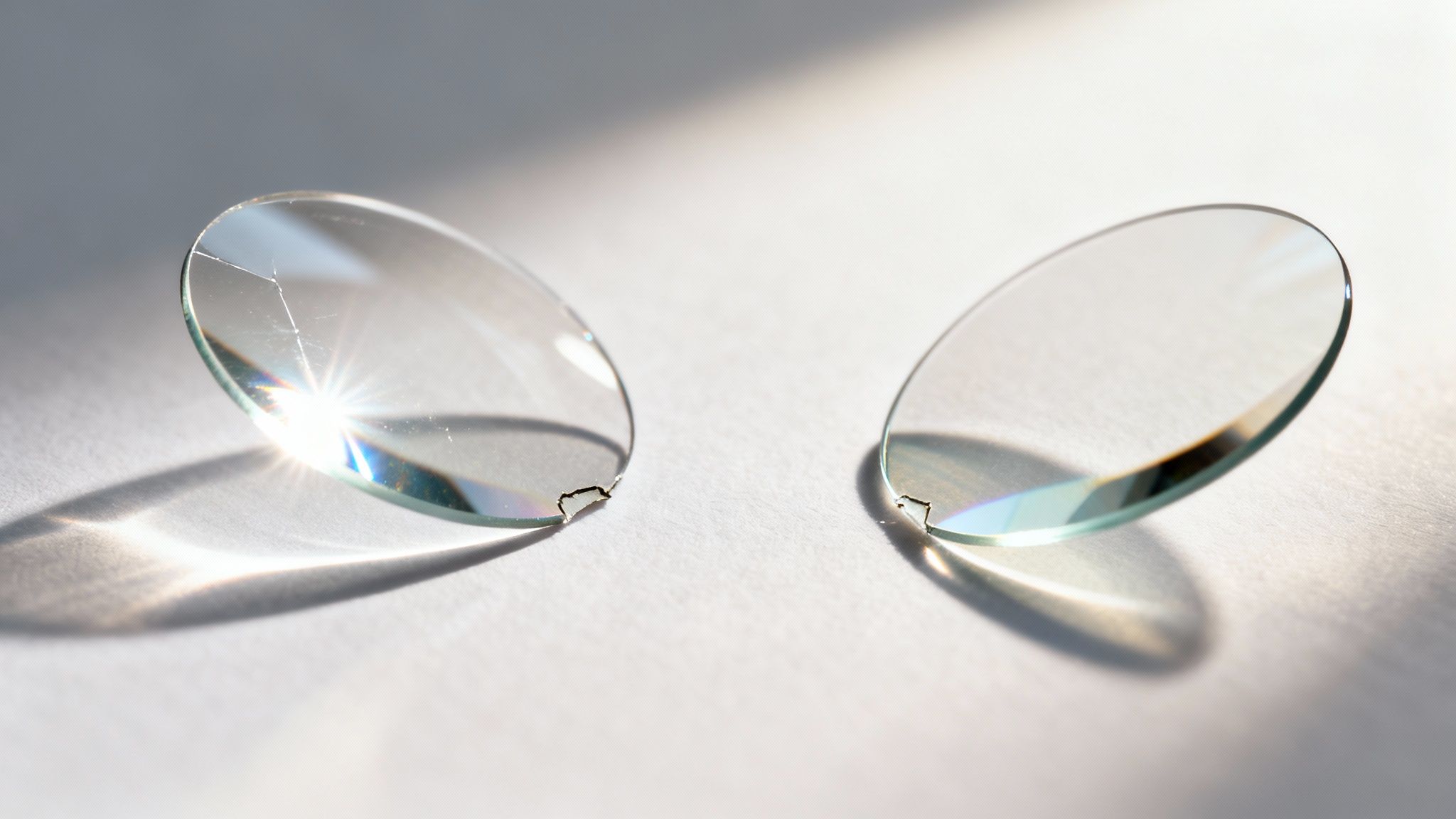
While scratch resistance gets most of the attention, the story gets interesting when you look at how sapphire and mineral crystals handle a hard knock. This is where the trade-off between hardness and flexibility comes into focus. It is a classic engineering paradox: the harder something is, the more brittle it can be.
Sapphire’s incredible hardness is its biggest advantage against scratches, but it is also its weakness when it comes to a sudden, direct impact. If you drop your watch onto a tile floor or hit it squarely against a granite countertop, that rigidity can cause it to shatter. It won't get scuffed, but it can break.
Mineral glass, being a bit softer, has more give. Faced with the same impact, it is more likely to absorb the shock. This might result in a chip or a crack, but it is less prone to shattering completely.
The choice really comes down to which risk you are more willing to take. Sapphire guards against the thousand tiny scratches of everyday life but is more vulnerable to one catastrophic hit. Mineral glass forgives the occasional hard knock but will show the battle scars that sapphire easily shrugs off.
For most of us, the daily grind poses a far greater threat than a major drop. This is why sapphire is the go-to choice for anyone who values long-term, pristine clarity. But if your job or hobbies put your watch in the line of fire, the superior shatter resistance of mineral glass is worth considering.
Optical Qualities and Dealing With Glare
Beyond toughness, the optical properties of the glass affect how you use your watch. The way light travels through the crystal has a direct impact on clarity and reflections, and the two materials perform differently.
The deciding factor here is the refractive index, which is a way of saying how much a material bends light. Sapphire has a higher refractive index than mineral glass, meaning it bends light more. This gives it a brilliant clarity, but it also makes the surface more reflective.
An uncoated sapphire crystal in bright sunlight will have a fair bit of glare, which can sometimes make the dial difficult to read. Mineral glass, with its lower refractive index, is naturally less reflective, making it a bit easier on the eyes in sunny conditions.
To solve this, watchmakers apply an anti-reflective (AR) coating to sapphire crystals. This microscopic layer is engineered to cancel out reflections, cutting down on glare and making the crystal seem almost invisible. A good AR coating can make a sapphire crystal even clearer than mineral glass, giving you both unbeatable scratch resistance and perfect legibility.
The Role of Anti-Reflective Coatings
An AR coating’s placement matters. It can be applied to the inside of the crystal, the outside, or both.
- Underside Coating: This is the most common and practical method. It reduces glare effectively, and the coating itself is protected from scratches by the tough sapphire above it.
- Topside Coating: Applying the coating to the exterior delivers the best anti-glare performance, but the coating is much softer than the sapphire and can pick up scratches over time.
- Double Coating: High-end watches often feature coatings on both sides for maximum clarity, but this carries the same risk of the outer layer getting scuffed.
The presence and quality of an AR coating are significant. Sapphire has a refractive index of about ~1.8 compared to mineral glass at ~1.47, which is what makes it so much more reflective. This is why many European brands insist on AR coatings to ensure their watches are perfectly legible in strong sunlight.
This combination—extreme scratch resistance, superb clarity, and a solid AR coating—is why many buyers now consider a sapphire crystal essential for a serious, long-lasting timepiece. For a deeper dive into the technical specs, GnomonWatches.com has an excellent breakdown.
Comparing Cost and Long-Term Value
When you're looking at a watch, the price is just the beginning of the story, especially when it comes to the crystal. Watches with sapphire crystals almost always cost more upfront. That is because creating, cutting, and polishing that incredibly hard material is a complex and energy-intensive process.
But it is important to think beyond the initial purchase. The real question is how that one-time premium for sapphire stacks up over the life of the watch. This turns a simple price comparison into a deeper look at durability and future maintenance costs.
For many, that slightly higher investment in sapphire is really a down payment on peace of mind and fewer trips to the watchmaker.
Upfront Investment vs. Ongoing Maintenance
A watch with a mineral crystal is easier on the wallet to begin with. The catch is its susceptibility to scratches. Over time, those little scuffs can cloud the dial and make a great-looking watch seem worn out.
Getting that crystal-clear look back means a full replacement, and that is a cost to factor in. If it is a watch you wear every day, this could become a regular expense, slowly reducing the money you saved at the start.
Think of it this way: the premium for sapphire is often a one-time cost for years of pristine clarity. The lower price of mineral glass might be an entry point to a cycle of future replacement costs if you value a flawless appearance.
Watch service centers in Croatia often see daily-wear watches with mineral crystals needing a replacement every two to three years just to keep them looking clean. This is especially true along the coast, where fine quartz sand is common. For more on this, you can find some great insights on crystal performance in this detailed guide by Nite Watches.
A sapphire crystal, under the same conditions, can easily look brand new for a decade or more.
Factoring in Your Personal Watch Habits
In the end, what offers the best value comes down to you and how you wear your watches. Are you a one-watch person, wearing the same piece everywhere? Or do you have a collection you rotate through?
- For the Daily Wearer: If you have a go-to watch that sees you through everything, the resilience of sapphire often makes more financial sense over five or ten years. It handles the daily grind and keeps looking sharp.
- For the Collector or Occasional User: If a watch is just one of many in a rotation, a mineral crystal can be a logical and cost-effective choice. It is far less likely to pick up significant wear, making its lower upfront price a win.
Remember, replacing a crystal is not just about the money; it is also the hassle of being without your watch while it is being serviced. Regular maintenance is a key part of owning a quality timepiece, but avoiding extra, preventable repairs is always a good thing. If you want to know more about the process, you might find our guide on what watch servicing actually entails helpful.
Thinking about these points will help you decide whether to invest a bit more now for long-term clarity or save upfront, knowing a replacement might be needed down the line.
Which Watch Crystal Is Right for You?
All the technical talk about Mohs scales and refractive indexes is interesting, but what really matters is how a watch crystal holds up in your world. The best choice is not about finding the single “best” material, but about matching the crystal’s strengths to your lifestyle and what you value in a watch.
Let’s break down the real-world differences between sapphire and mineral glass for three common types of watch owners.
For the Office Professional and Dress Watch Enthusiast
If your watch’s typical setting is the office, a client meeting, or a formal event, its main enemies are the small scuffs of everyday life—brushing against a filing cabinet, dragging a cuff over a desk, or an accidental knock on a doorframe.
In these environments, sapphire is the ideal choice. Its near-diamond hardness means it simply ignores these minor encounters, emerging without a blemish.
For anyone who wants their watch to look pristine day in and day out, sapphire offers incredible peace of mind. It keeps your dress watch looking sharp and flawless.
A mineral crystal can certainly work in this environment, but it will eventually start to show fine hairline scratches. Over time, these marks can catch the light and make the watch look a bit tired. When a timepiece is meant to be a polished accessory, that flawless clarity is important.
For the Hiker, Adventurer, and Field Watch User
Once you step outside or get your hands dirty, the game changes. The risk of light scratches is still there, but now you also face the possibility of a hard, direct impact—like hitting your watch on a rock or dropping it on a hard surface.
This is where the choice between sapphire and mineral glass gets more interesting.
- Scratch Resistance: Sapphire is still the top performer. It will fend off scrapes from branches, rock faces, and tools far better than mineral glass. The dial will stay perfectly clear.
- Impact Resistance: This is where mineral glass makes its case. It has more flex than sapphire, so a sharp knock is more likely to leave a chip or a deep scratch. Sapphire, being harder and more brittle, has a greater tendency to shatter completely from that same hit.
So, it comes down to which risk you’d rather take. If you can’t stand scratches and are careful enough to avoid major impacts, a sapphire crystal on a field watch is an excellent choice. But if you accept a few scratches as part of an active life and want a crystal that’s less likely to fail catastrophically from one bad hit, mineral glass is a tough, reliable option.
For the Style-Conscious Collector
For enthusiasts who see watches as a form of self-expression and rotate through different pieces, the considerations shift. When any single watch is only worn occasionally, its exposure to daily wear and tear is dramatically reduced.
In this scenario, a mineral crystal strikes an excellent balance. It offers adequate protection for the days it is on your wrist while helping to keep the watch's price more accessible. This frees up your budget to explore a wider variety of designs, brands, and styles.
Of course, sapphire is always a premium feature that many collectors seek out. But if your goal is to build a diverse collection, the practical durability and value of mineral glass make it a logical and satisfying choice. It lets you enjoy the unique character of more watches.
Common Questions About Watch Crystals
Even after weighing the pros and cons, you might still have a few questions. Let's tackle some of the most frequent ones we hear.
Can a Sapphire Crystal Actually Break?
Yes, it absolutely can. Don't let the "scratch-proof" reputation fool you into thinking it is indestructible. While sapphire is a champion against daily scuffs, that hardness makes it more brittle. A hard, direct shock—like dropping it on a ceramic tile floor—can cause it to shatter.
Mineral glass has a bit more give. It is more likely to chip or crack from that same impact but is less prone to completely shattering. You are choosing between near-total immunity to everyday scratches (sapphire) and better resistance to a single, hard knock (mineral).
Can I Polish Scratches Out of My Watch Crystal?
That depends on the material. If you have a scratch on a mineral crystal, it is pretty much there to stay. The material is not suitable for polishing, either at home or by most jewelers. Once the marks get bad enough to bother you, your only real option is a full replacement.
Sapphire, on the other hand, is so tough that you will likely never scratch it in the first place. In the rare event that you do manage to mark it—say, with a diamond ring—polishing it out would require specialized industrial equipment.
The bottom line is this: think of mineral crystal scratches as permanent and sapphire scratches as a near impossibility. Neither can be fixed with a simple DIY polish.
How Can I Tell if a Watch Has Sapphire or Mineral Glass?
Without looking at the spec sheet, it can be tough, but there are a few subtle clues. Sapphire sometimes has a cool, slightly bluish tint when viewed from an angle. Another old enthusiast's trick is the water drop test: a drop of water will bead up tightly on sapphire but will spread out more on mineral glass.
Honestly, though, these aren't foolproof methods. The only way to know for certain is to check the watch's product description or look at the case back, because manufacturers who use sapphire are usually proud to state it.
Does the Shape of the Crystal Matter?
It does. The crystal's shape—whether it’s flat, domed, or has a "box" profile—affects both its resilience and how the watch looks. A high-domed crystal, for instance, looks great and gives the dial vintage charm, but it is also a bigger target for side impacts.
A flat crystal is the modern standard, offering a clean view. The shape does not change the core properties of the material itself, but it does alter how the crystal handles light and interacts with the world around it.